– The Great Abode –
A spiritual sanctuary dedicated to the Great Mother of creation – Maha Alaya
Mahalaya means the great abode. It's a spiritual sanctuary that honors the Divine Mother of creation, a place of practice and mysticism grounded in the ancient Hermetic tradition as it has come down to us from the ancient civilizations of the past, through the esoteric traditions of the East and West.
The transmission
One teaching, many hands
The Hermetic teaching didn't begin with anyone now living. It came forward through a long chain of keepers, went underground for centuries at a time, and surfaced again when it was allowed to. This is that chain as passed down through the ages and recorded by Hermetic Teachers.
-
Before the record
Mû
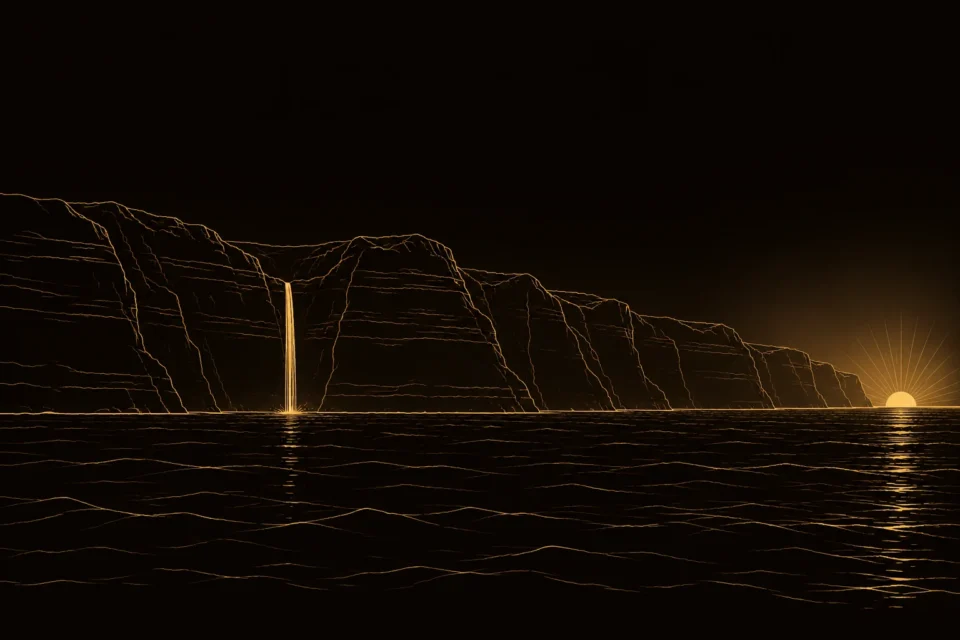
The submerged Pacific homeland. The account puts the deepest root here, and reads its traces in language itself. It notes that Hebrew is written right to left because in Mû the sun rose in what we now call the west.
The transmission in full
Nothing stands behind this one. The account places the deepest root of the bequest here, older than Atlantis, and treats Mû less as a stage in the transmission than as the ground the transmission starts from.
The place is a continent in the Pacific, submerged in the first great catastrophe, which came with a shifting of the poles. In that era the sun rose at the cardinal point we now call west and set in the east. The framework behind this is Blavatsky's root races, cited directly: Mû corresponds to the third, Atlantis to the fourth.
What it handed on is not a text or a school but an orientation, preserved in writing itself. Hebrew still runs right to left because that followed the sun's course in the Mûan sky, and Arabic is treated as the same survival. The Atlantean language, from which Egyptian descends and which is given as the root branch of the Indo-European family, reversed direction once the sun began rising in the east.
-
The first catastrophe
Atlantis
The Teaching held by an initiate priesthood, then turned to darker use, then lost with the continent. The account of the transmission itself begins here.
The transmission in full
The front-matter list of the carriers of the Wisdom opens here, with the Priests of Atlantis, even though the fuller lineage statement puts Mû earlier still. Whatever came from Mû, Atlantis is where the account has an initiate priesthood holding the Teaching in an organised form.
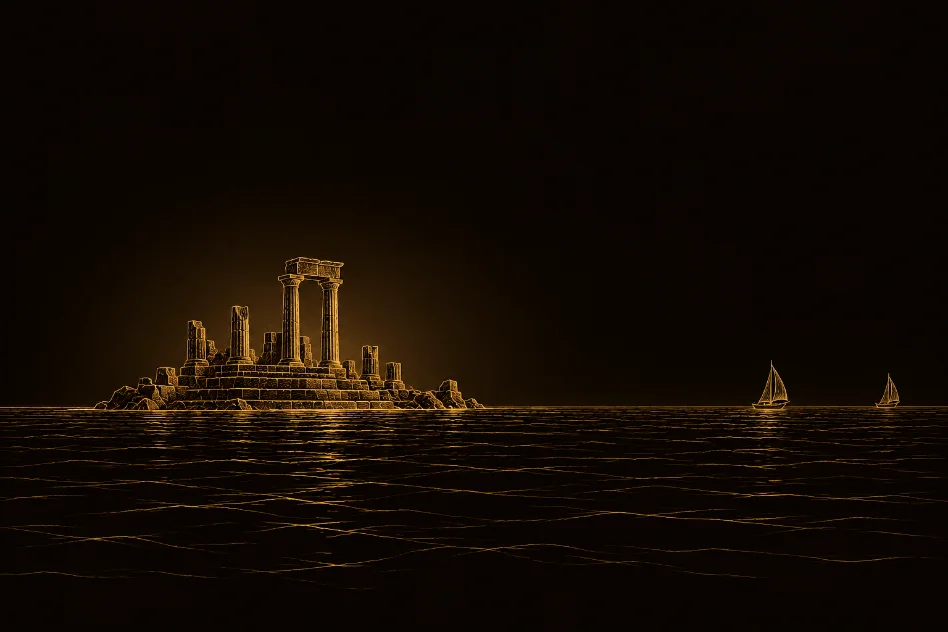
The continent lay in the Atlantic and subsided around twelve thousand years before our era, its last remnant, Poseidonis, going under around ten thousand. Its reach was wide. Atlantean colonies are placed around the Mediterranean, in Greek Thrace, in Crete, and across the Cyclades, which is how the same inheritance later turns up in more than one place at once.
Then it was turned. The account calls what happened there the most monstrous practice of black magic ever made, and says it destroyed the continent and left humanity a karmic debt it has been dragging for thousands of years. On that reading the millennia of war and ignorance since are the discharge of that debt, and it was not substantially cleared until 1945. What survived the catastrophe was carried east by surviving initiates, to India.
-
After the flood
India
The refuge. From the Aryavarta the teaching radiated back out across the whole of the Orient.
The transmission in full
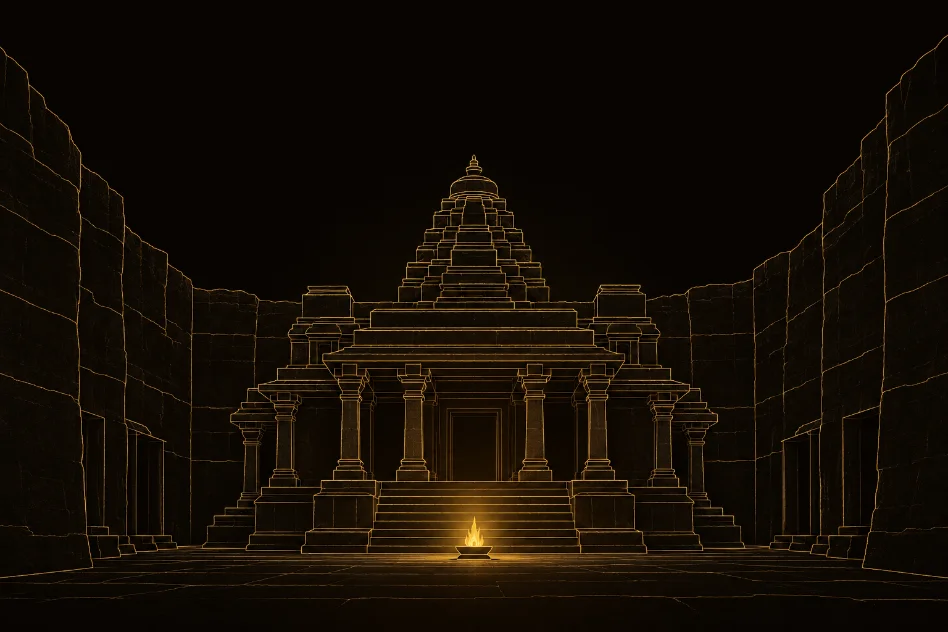
India is the refuge. After the Atlantean catastrophe the surviving initiates brought the Wisdom to the Aryavarta and rebuilt it there, in the Vedic and post-Vedic schools. The Priests of the Aryavarta stand beside the Priests of Atlantis in the list of carriers, which makes this the first reconstruction rather than a simple relay.
Aryavarta is the land of the noble ones. The account takes Arya back to the root Ar, meaning fire and light, and glosses the Aryas as the Sons of Fire and then, by extension, the Saints. Fire is the practice as well as the name. The public festivals gave grace to Fire at dawn, at noon and at sunset, and there were other rites, more secret, that began at twilight and ended before dawn, when Fire was no longer manifested by the sun.
From there it radiated. The account has the teaching going back out across the whole of the Orient, reaching Chaldea, and reaching Egypt by a partly separate route. One small piece of evidence it offers for the Egyptian link is the word misi, which it gives as the proper designation of Egypt and calls Indian in origin.
-
Antiquity
Chaldea and Egypt
Egypt as a mixed colony, Atlantean in the deepest past and Indian after it. The Egyptian mystery schools were the continuation, not the origin.
The transmission in full
Egypt did not originate this. The account is blunt about it: Egypt was a mixed colony, Atlantean in very distant times and Indian afterward, and it says that double inheritance is exactly what gave Egyptian symbolism its genius. Chaldea, in southern Mesopotamia, received its share from the Indian radiation. The Egyptian mystery schools are the continuation of something older, not its source.
One man is credited with putting it back together. He was called Heroumos, Child of Hérou, which is to say of Hôr, Horus, the Living God, and the Greeks turned the name into Hermes Trismegistus, the Thrice Great. The account is careful about what he did and did not do. He did not invent the Wisdom. He reconstituted the scattered knowledge Egypt had inherited from Atlantis, purified it, polished it, and laid the foundations of all Knowledge in the form that then descended through Egypt into the Western inheritance. He lived in the fourteenth century before our era, and his stature was such that later tradition confused him with the god Thoth himself.
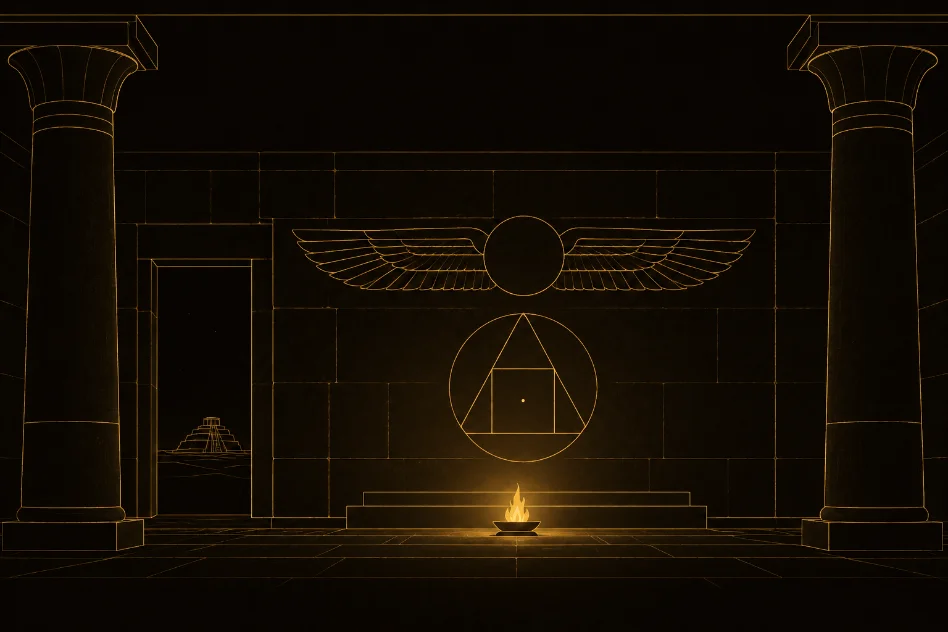
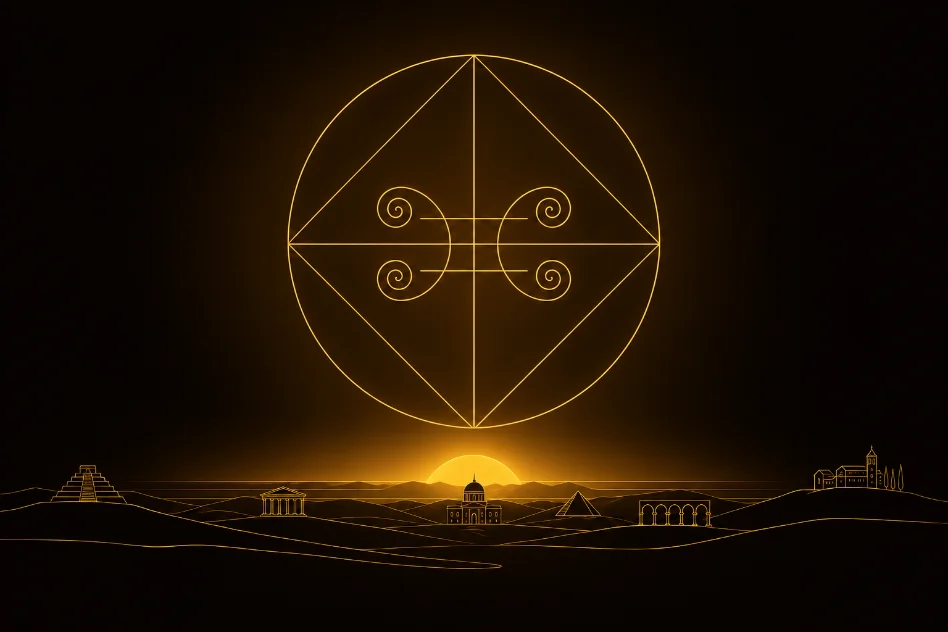
What Egypt did was refine the method. The teaching passed without speech. The account's second chapter follows an Egyptian priest instructing a novice across seven days in silence, using gesture alone. He indicates the winged solar disk on the wall: the disk is the One, the two wings the Two, the three rows of feathers on each wing the Three. Then he traces the figure whole, from the centre point out to the circumference, drawn from the top and turning rightward, an equilateral triangle inscribed with its points on the circle, and a square raised on that triangle's base. Centre, circle, triangle, square, and the Septenary in them. The common language of initiates across countries, on this account, was never a spoken one. It was number and geometry.
The school itself has a name, and it is hers. The teaching that came down from Mû through Atlantis and India into Egypt is said to have been dispensed by the School of Sirius, called that to mark the link between our solar system and that star, and the account also calls it the Isiac Royal School. The governing Being of Sirius is Aset, Isis, the Great Provider, who channels the Divine Intelligence into our system and whom the account names the Divine Mother. This is the same Mother invoked at the close of every one of these lectures. The account adds, without elaborating much, that Beings from other systems were present on Earth in those distant times and had a hand in the teaching.
It also closed here first. The Egyptian sanctuaries were officially shut in 1369 before our era at the coming of the Dark Age, and the Teaching was veiled from that point on. What went forward went to Greece, chiefly through Pythagoras, who took his initiation in Egypt.
-
Classical Greece
Pythagoras to the Neoplatonists
Pythagoras, Empedocles, Plato, and the schools that carried them. The account is just as clear about who broke the line as about who kept it.
The transmission in full
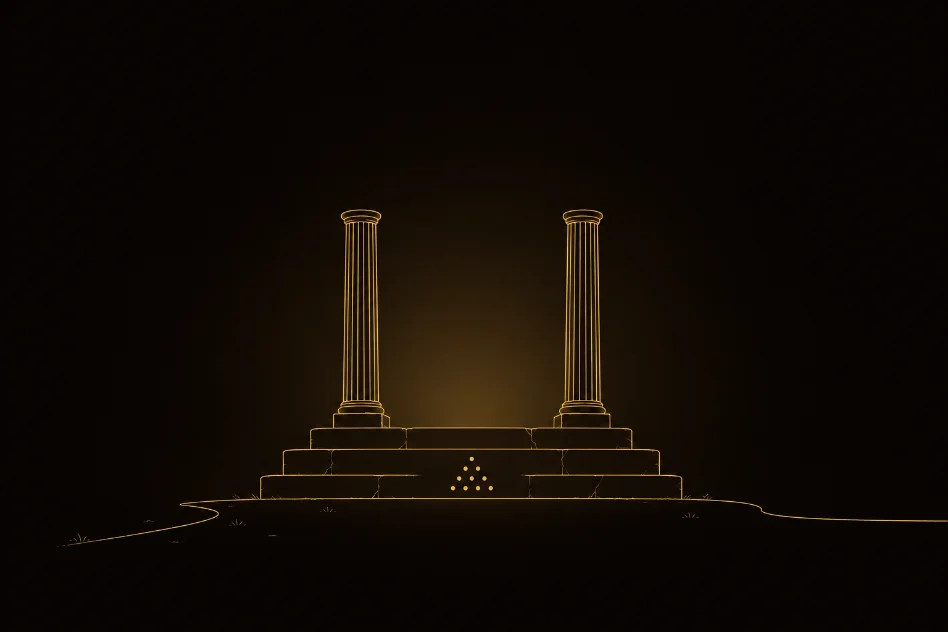
Greece received it by initiation rather than by translation. Pythagoras went to Egypt and was initiated there, and the line the account honours runs from him through Empedocles of Agrigentum in the fifth century to Plato, and on into the Neoplatonic schools of Alexandria.
It also says there were two streams in Greek philosophy, not one. Against the Egyptian-Hermetic line it sets a materialist counter-stream in the Sophists, naming Protagoras and Gorgias, and then Aristotle, who is described as having renounced his master Plato and founded the deformation that would later poison Western philosophy. The account is unambiguous on this, and it is worth knowing that it is a position rather than a consensus.
The Greek line did not fade. It was closed administratively, in two waves. Theodosius the First shut the temples and prohibited pagan worship between 389 and 392. Justinian closed the Neoplatonic School of Athens between 529 and 532 and suppressed freedom of conscience with it. By the time either edict landed, the part that mattered most had already gone.
-
The Hebrew line, fifth century before
Ezra and the hidden books
Twenty-four books published, seventy kept back for the wise. The seventy are where this account puts the root of the Kabbalah, and the complete Knowledge stayed in restricted circles in Persia, in Chaldea, and in Nazarene and Essene milieux.
The transmission in full
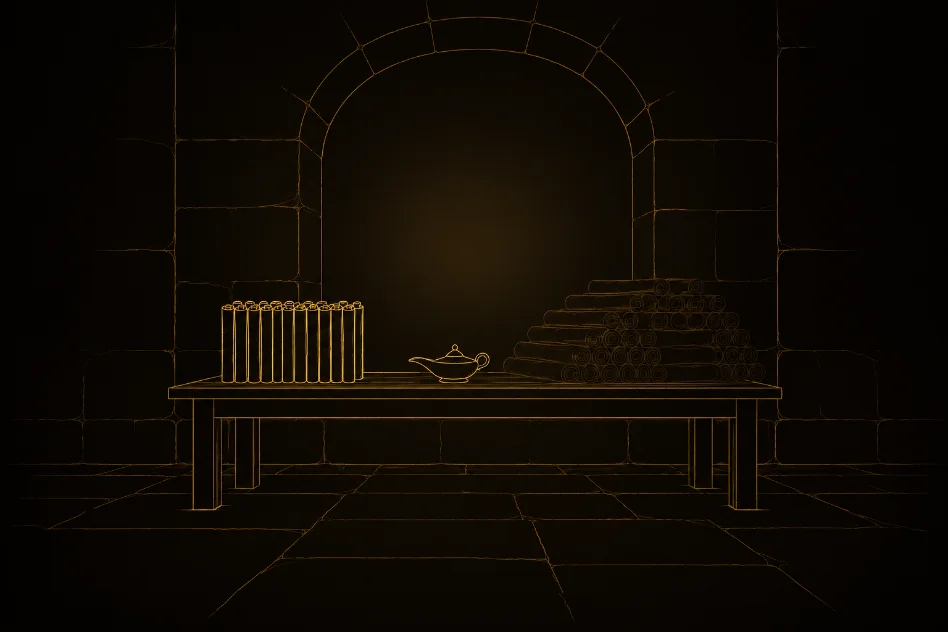
The Fragments themselves come out of what the account calls the Mother-Branch, Egyptian and Chaldean. Their delivery is dated precisely. After the destruction of the Temple, Ezra dictates ninety-four books in forty days. Twenty-four are to be published so that the worthy and the unworthy alike may read them, and those are the canonical Hebrew Bible. Seventy are held back and given only to the wise, the Perouchim, the separated ones, set apart by initiation rather than in the later pejorative sense the word acquired. The account takes the fourteenth chapter of Fourth Esdras as the textual warrant for a hidden transmission running alongside the public canon.
From the fifth century before our era to the middle of the first century after it, those Fragments are the foundation of Israelite esotericism. The complete Knowledge is another matter, and stayed confined to restricted circles: the diasporic priestly schools of Persia and Chaldea, which still had access to the older Chaldean Wisdom, and the Nazarene and Essene milieux of Palestine. When the Temple fell between 66 and 70 and the population dispersed, two streams went into exile together, the fixed canon and the Fragments. The canon was settled around the year ninety. The Fragments took centuries longer to be written down at all.
The medieval texts are treated with respect and reservation in equal measure. The Sepher Yetzirah, the Book of Formation, and the Sepher ha-Zohar, the Book of Splendors, are called luminous at the core but laden with rabbinic glosses, some of them genuinely inspired and some of them erroneous, which makes the received Kabbalah a layered work of preservation and partial corruption. Schools of exegesis multiplied after the Diaspora, and the Fragments, commented and re-commented, passed into Spain and the south of France and from there into the whole West. That is the same corridor the Arabic transmission travelled, which is why these two lines meet at Andalusia rather than running on separately.
-
The Hebrew line, first century
Jesus, the Essene
Formed in the Essene schools, and named by a triple identity: the man, the cosmic principle that descended on him, and the brotherhood he came out of. His teaching is treated as a Hermetic teaching delivered in Aramaic. The Church that followed is treated as a deformation of it, and kept separate from him.
The transmission in full
He is not an outside figure brought in for comparison. The Essenes, a Jewish community of mystics and ascetics of the late Second Temple period with connections back to the older Egyptian and Therapeutic streams, stand in the account's own list of the carriers of the Sacred Science, between the Hierophants of Egypt and the inner circles of the Kabbalists. The book's dedication names him by a triple identity: Jesus the man, Christ the cosmic principle that descended on him, and the Essene, the brotherhood that formed him. His teaching is described as a Hermetic teaching delivered in Aramaic, and because the complete Kabbalah was held in exactly those Nazarene and Essene circles in exactly those centuries, the account calls him a master of the true Kabbalah.
He was not called Jesus at birth. The account gives his birth name as Joseph, the same as his father's, and says he took the name Yeschoua only when his Mission began, so the change of name marks the taking up of an office rather than a person. It also says he was not Jewish. He was a Semite of an ethnic branch issued from the Atlantean emigration and settled in the Orient, which is to say Essene, and it reads Nazarene as a lineage word rather than a place, since the town did not exist at the time, naming instead the Nazarites who were closely bound to the Essenes and kept the same Atlantean inheritance. The Essenes are described as an Order rather than a people, because the criterion of belonging was initiation, with men, women and children living in community, and their initiatic origin given as Chaldean Kabbalah and Egypt.
His clothing is read as evidence. He wore a great blue mantle over a white linen robe, as many of his Brothers did, and the account takes that blue and white as the vestment of a Priest of Aset-Isis. The Madonna's blue mantle, on this reading, preserves the same priestly garment rather than inventing a colour for her. The book's own dedication is made first to those of the Great Blue Mantle.
A second mission ran alongside his. Apollonius of Tyana, born in Cappadocia in the early first century, is called the Secret Companion of Christ, working in parallel and complement to the historical mission. The Christ is also placed cosmically rather than only historically: manifested through Tiphereth in the mode the East calls the Bodhisattva, and identified with Hôr, the Egyptian Horus, the Logos of our own solar system.
What follows is where the account divides sharply. It holds that the traces are still in plain sight and simply unacknowledged. The Madonna and Child is Aset with Horus, and it notes that the Christian tradition took the image over without referring to Isis. The Hebrew name of Jesus is read as the Pentagrammaton, Yiéschoua, the four-letter Name of God with Shin inserted at its centre, so that the name itself carries the four elements plus spirit. And then the institution: a Church persecuted at its origin became, from the end of the fourth century, the power that closed the sanctuaries and the schools it had inherited from. The figure stays inside the lineage. The institution is called a deformation of it.
-
Second century onward
The Withdrawal
The most secret manuscripts leave Alexandria quietly for northern India, and from there into the Mathams, the closed centres of Tibet. Apollonius of Tyana withdraws the current. The West goes dark.

The transmission in full
The decision came before the persecution. In the course of the second century the most secret manuscripts were quietly conveyed east, to the north of India. Ammonios Saccas, who founded the Neoplatonic school at Alexandria and taught Plotinus, attempted a resurgence in the same period, and the account treats the attempt as insufficient because the higher hierarchy had already resolved to withdraw the textual core.
Their destination is named. From the seventh to the twelfth century the manuscripts coming out of the Eastern Mediterranean, Asia Minor and then northern India itself were kept in the Mathams, the secret centres of Tibet. The withdrawal was ordered by Apollonius of Tyana before he withdrew the current himself.
So the edicts arrived too late to do the damage they intended. When Theodosius moved against the ancient religions, the Tradition was already protected at its core, and what was destroyed was the external form. This is also why the deepest archive of the Western line spent its long exile in the East.
What was withdrawn was not only paper. The account calls the Egregore of the tradition its energetic nucleus, a diamond-energy core that supports and animates every outward form the tradition takes, and says this is one of the most important teachings in the whole book. Apollonius withdrew that nucleus from the use of men at the end of his mission and ordered the manuscripts east in the same act. Both cores left together, which is why the account describes the Western tradition afterward as put on standby rather than destroyed, waiting on a re-divulgation that would not begin for seventeen centuries.
-
Ninth century
Harrân and Baghdad
A Neoplatonic school survives past the Euphrates. Syriac scholars carry the texts into Arabic, and the School of Baghdad is founded by Tâbit ibn Qurra.
The transmission in full
Shattered in the empire, the Knowledge took refuge outside it. A Neoplatonic school survived beyond the Euphrates, on the Persian frontier, out of reach of Constantinople and of the papal thunderbolts. Carrhae in Latin, Harrân in Aramaic, in upper Mesopotamia. Being on the far bank is the whole reason it lasted.
It lasted a long time. The school ran from the sixth century into the eleventh, when the Seljuk Turks finally extinguished it, which gave the Western Tradition more than five continuous centuries of operation while Europe had none. In parallel, from the fourth century onward, the Syriac Doctors of Edessa, Christians well acquainted with the ancient Wisdom, had been translating the texts, and the account pays them explicit homage for it.
The handoff is a single named man. Tâbit ibn Qurra, a Sabian of Harrân who lived from 836 to 901, founded the School of Baghdad. That school carried the knowledge onward in Arabic, westward across the Islamic world, to Andalusia and the School of Córdoba.
-
1459 and after
Córdoba, then the Renaissance
Andalusia and the south of France pass it into Europe. Operative Freemasonry is refounded under the Rose and the Cross, and Florence receives it through Pléthon, Ficino, Pico, and above all Giordano Bruno.
The transmission in full
Córdoba received it from Baghdad in Arabic, and then it went quiet for a long time. For nearly six centuries, from the ninth to the middle of the fifteenth, the Hermetic Tradition made its way into the West scattered and isolated, in groups active in the south of France and in Spain, with no centre and no continuity of institution.
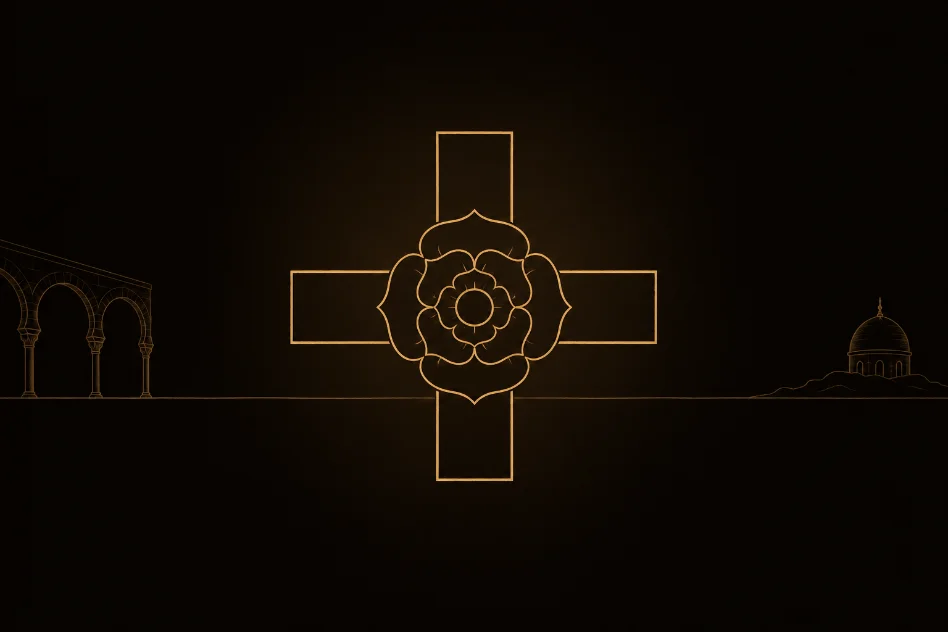
1459 is the date the account gives for its refoundation, when it was at last able to constitute itself into operative Lodges under auspices inherited from ancient Egypt, those of the Rose and the Cross. Operative here means theurgical and effective, as against the speculative Freemasonry that emerged later and which the account regards as a weakened form. It goes further: the diamond nucleus of the authentic Masonic egregore is the Rose-Cross, the Rosicrucian fraternities are an externalisation of an older Mother-Branch rather than its source, and that Mother-Branch is what it calls the School of Sirius, with a footnote stating plainly that true Freemasonry finds its sources in that Isiac school. Which puts the refoundation of 1459 back at the same Sirian and Isiac source as Egypt, four thousand years earlier.
Florence happened alongside it. Gemistos Plethon left the seal of his passage there in 1439. Ficino translated the Hermetic Corpus and then Plato for Cosimo de' Medici, putting both within reach of the Latin West for the first time in centuries. Pico della Mirandola brought the Kabbalah into Christian hands. And Giordano Bruno, 1548 to 1600, is named as the high point of the whole Italian flowering, and carried it to martyrdom.
-
Eighteenth and nineteenth centuries
Saint-Germain, then Theosophy
The Masonic movements, the Comte de Saint-Germain, the unfinished work of Cagliostro. Then Blavatsky, the Theosophical Society, and the theurgic orders that followed.
The transmission in full
Between Bruno and the eighteenth century the account describes a long underground with little to show. What brought it back into semi-public view was the work of the Masonic movements, the presence of the Comte de Saint-Germain, and the mission of Alessandro di Cagliostro, which it calls unaccomplished. Cagliostro died in the Inquisitorial prison of San Leo in 1795 with the work unfinished.
Saint-Germain is not treated as a colourful figure but as an Adept of the tradition working in the open. The account quotes Blavatsky calling him the greatest Oriental Adept Europe had seen in many a long century, and adding that Europe did not know him.
The open re-emergence came later, at the end of the nineteenth century, with Blavatsky's founding of the Theosophical Society in 1875 and the theurgic orders that followed in its wake. The timing is deliberate in this telling. The re-divulgation was permitted in anticipation of a karmic clearing that had not yet happened, which is why it went only so far and no further.
-
1956
Franz Bardon
On this reckoning the old debt is settled and magic may be taught openly again. Bardon's books appear, and the current we practice in today opens.
The transmission in full
Here the account puts a date on permission itself. The Atlantean debt was substantially discharged by the two World Wars, and only after 1945 was the diffusion of Magic, in the authentic sense of the word, authorised by Cosmic Law. Everything before this point in the chain is transmission under restriction.
Then, in 1956 and 1957, the works of Franz Bardon appeared, and the account calls them the masterpiece of all esoteric literature relating to Magic. The claim is not that they are a good twentieth-century publication. It is that they are the authorised opening of the present cycle of practical transmission, and everything the account teaches afterward rests on that.
The century around them is read the same way. The account describes a conflict in which practices of black magic founded an ideology and supported the war, and points to Frabato the Magician as a veiled account of that period.
-
Now
SOLANCHA
The Hermetic stream continues with a new transmission. SO LAN CHA, the three primordial trinitized energies that make up all of creation. Encoded in each word is the frequency and the principle of the creative force it carries. Together they make up the creative law of harmony and balance.
The transmission in full
The Hermetic stream continues with a new transmission. SO LAN CHA, the three primordial trinitized energies that make up all of creation, received as a language of their own. Encoded in each word is the frequency and the principle of the creative force it carries. Together they make up the creative law of harmony and balance.
These forces aren't a discovery. Every station above worked with them under whatever names its tongue allowed. What's new is the encoding. The words don't describe the forces from outside. They carry them.
Two primary forces, and a third that comes of their meeting. That is what trinitized means.
SO
The feminine, magnetic quality. Expressed as contraction, receptivity, nurture and stillness. It draws inward, gathers and holds. Its element is Water.
CHA
The masculine, electric quality. Expressed as expansion, assertion, creativity and motion. It moves outward, radiates and initiates. Its element is Fire.
LAN
The third that arises where the two meet. Not a midpoint between them and not a blend of them. Wherever two forces meet, the meeting itself generates a third, and LAN is that third when the meeting is in balance. Expressed as harmony, mediation and equilibrium. Its elements are Air, where neither force dominates, and Earth, where both are bound into form. When the meeting is out of balance a third still comes, but it comes as distortion. Nothing is neutral.
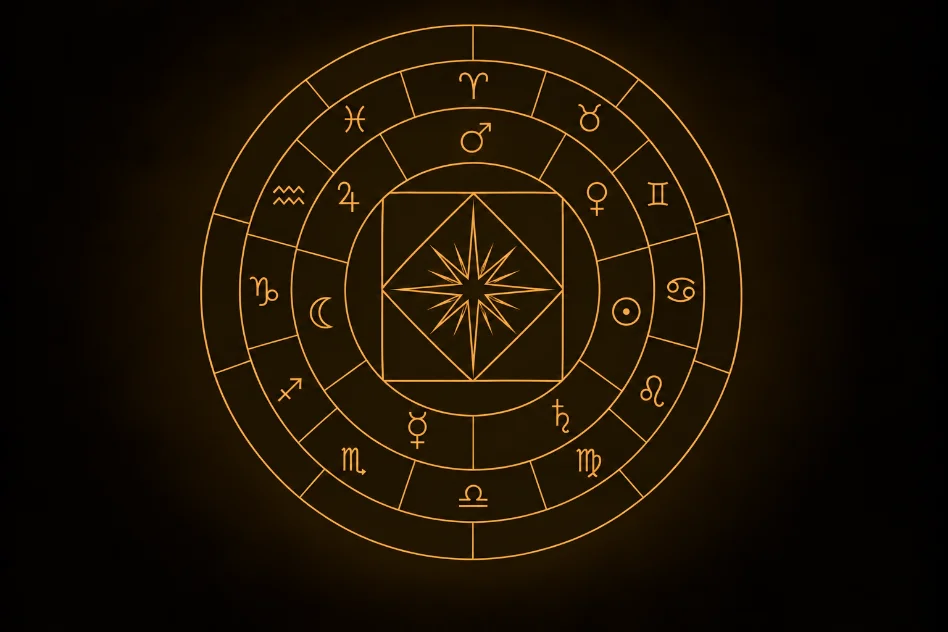
Bardon named these same two forces the electric and the magnetic fluid, and how they produce the elements is the point. Fire is the electric fluid, hot and dry and expansive. Water is the magnetic, cold and moist. Air is the neutral fluid, where neither one dominates. Earth is the electromagnetic, both of them present and bound together, which is why it's the element of form and of consciousness. Two forces, four elements.
The three spring from Akasha, the unmanifest and undifferentiated ground, The Great Mother – Mahalaya. From their trinitized action the four elements arise, and from the elements all of manifest reality is built. That's the whole sequence, and the same law runs through every scale of it, from the cosmos down to an ordinary hour in a person's day. The name of this work is those three syllables sounded together, with LAN in the middle because the middle is where it comes from.
The eight spiritual laws are how that law unfolds, and SOLANCHA studies them as creative principles rather than as commandments. They form a causal stream, each building on the one before it: Motion, Polarity, Manifestation, Cause and Effect, Harmony, Attraction, Growth, Balance. They're the living expression of how SO, CHA and LAN move through reality. Worked with deliberately they're a path of self development, and the sequence completes in the lived state of harmony and balance, the point at which someone stops reacting to their life and begins consciously shaping it.
And Mahalaya is the living self-aware intelligence of Akasha. The great abode is the great storehouse, the unmanifest ground the three forces spring from. It's the name of the Great Mother, and the name of the sanctuary being built in her honor.
The tradition is called Western only to tell it apart from the East, which in this account doesn't differ in substance at all. It differs in its symbols. One doctrine, two languages. India sits inside the Western line rather than beside it, and the texts spent their long exile in Tibet. Honoring both expressions isn't a gesture toward balance. It's the same stream, read in two scripts.
The chain above follows Alexandre Moryason's La Lumière sur le Royaume, second edition, and his Table of the Transmission of the Western Esoteric Tradition.
SOLANCHA and Mahalaya have no direct affiliation with Alexandre Moryason or his work.